Enigma Machine
Enigma machine simulator processes letters with your selected three-rotor settings, ring settings, initial windows and plugboard. Use the same settings and reset the initial windows for the reciprocal operation; the tool does not find missing settings.
Current settings
Ready. The same configured operation works in both directions.
View stepping positions
No steps yet.
Public known-setting checks, calculated twice
We calculated these published cases with this page’s JavaScript simulator and an independently implemented Python simulator. Output letters, final windows and step traces matched. Resetting each machine to the original settings and processing its output returned the stated input. The table is generated from our calculations, not copied from another tool.
| Controlled setting | Input | Calculated output | Reset and process output | Final windows |
|---|---|---|---|---|
| Public short vector I / II / III; rings AAA; start AAA; reflector B; plugs none | AAAAA | BDZGO | AAAAA | AAF |
| Public message-key example II / IV / V; rings BUL; start WXC; reflector B; plugs AV BS CG DL FU HZ IN KM OW RX | BLA | KCH | BLA | WXF |
| Public communication example II / IV / V; rings BUL; start BLA; reflector B; plugs AV BS CG DL FU HZ IN KM OW RX | THEXRUSSIANSXAREXCOMINGX | NIBLFMYMLLUFWCASCSSNVHAZ | THEXRUSSIANSXAREXCOMINGX | BLY |
| Public double-step window case III / II / I; rings AAA; start KDO; reflector B; plugs none | AAAAAA | ULMHJC | AAAAAA | LFU |
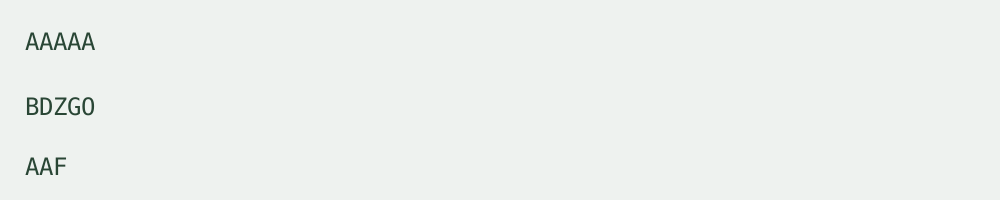

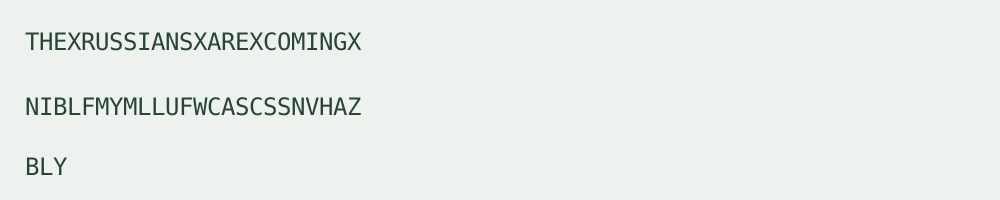
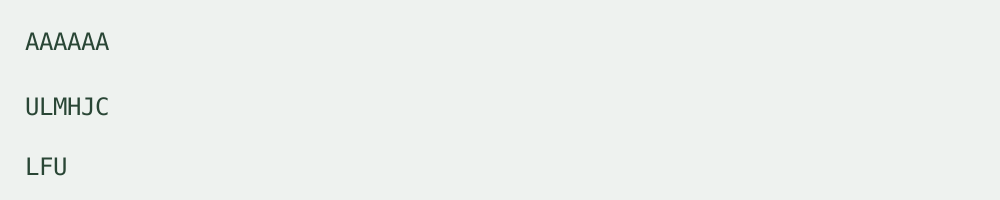
The short AAAAA example and double-stepping window sequence are recorded in the public implementation test suite. The message-key and communication examples, with II / IV / V, rings B / U / L and ten plug pairs, are published in the known-setting communication guide. For the fourth case, the published expected value is its window sequence; its output letters were computed by both implementations here.
The double-step sequence starts at KDO with III / II / I and rings AAA. Processing six A letters visits KDP, KDQ, KER, LFS, LFT and LFU. The middle rotor advances on consecutive relevant steps; it is not a simple odometer. We additionally compared all 60 different three-rotor orders from I–V with varied ring and start positions, both reflectors and plug pairs. Every checked case matched in both implementations.
To reproduce a row, enter every setting shown, process its input, then use the result with the original settings. Do not begin the second run at the final window position. Whitespace removed during input preparation is not recreated.
Machine scope and controls
This is a historical three-moving-rotor Enigma learning simulator using rotors I–V and reflector B or C. Choose three different rotors in left-to-right order. Ring settings and initial window letters are A–Z; A corresponds to 01. The ring setting offsets electrical wiring while the visible initial position sets the starting rotor orientation. Reflector and plugboard are part of the settings, not decorative controls.
The right rotor steps before each letter is processed. The middle and left rotors advance at their applicable turnover conditions, including the middle rotor’s double step. The signal passes through the plugboard, right-to-left rotors, reflector, reverse rotor path and plugboard again. This page does not model four-rotor naval machines, thin reflectors or rotors VI–VIII.
Input, output and limits
Use English letters and whitespace only. Input is uppercased and whitespace is removed. Digits, punctuation and other letters are rejected. Input is limited to 20,000 characters and 10,000 processed letters per run. Plugboard settings accept up to ten pairs of different English letters, separated by whitespace or commas; a letter may appear in only one pair.
Output is uppercase text with one-click copy. Every run starts from the displayed initial settings; final windows and the first 64 step positions are shown separately. No login, registration, uploads, batch mode, saved history or daily counter. All processing stays in your browser.
Can this find unknown settings?
No. It does not guess settings, identify a message’s configuration or offer a general ciphertext solution. Historical analysis depended on additional information and constraints; that is not a capability provided by this simulator. Use this machine for learning, not protecting confidential information.
How is it different from Playfair?
Playfair transforms letter pairs using a fixed key square; this simulator uses a changing rotor state and a plugboard. Both are historical learning tools. Other explicit operations are Caesar and ROT13, Atbash, Vigenere, Pigpen, Substitution Cipher, Bacon Cipher and Rail Fence. Cipher Decoder displays controlled alternatives.
Related known-setting walkthrough
This existing video demonstrates rail fence with a known rail count, not Enigma setting discovery.
Loading the player connects to YouTube and shares connection information such as your IP address and playback requests.