Cipher Decoder
Cipher decoder displays all 26 Caesar decode shifts, ROT13, Atbash and a Vigenere result when you supply a key; it does not identify a cipher, crack it or decide which result is correct.
Ready. No automatic identification or cracking.
Caesar decode shifts — all alternatives
Shift 0 leaves the input unchanged. Each other row subtracts its stated shift. No row is ranked as the correct answer.
ROT13
Atbash
Vigenere with your key
Supply a key to run Vigenere.
Original forward and reverse checks
We created these four text samples, generated ciphertext with the specified method and decoded it back. Python independently calculated the transformations; this page’s JavaScript matched each recovered text. All 26 Caesar rows for each sample were also compared with Python. The table was generated from these calculations.
| Method / supplied setting | Original text | Generated ciphertext | Recovered text |
|---|---|---|---|
| Caesar shift 3 | Hello, World! 123 | Khoor, Zruog! 123 | Hello, World! 123 |
| ROT13 | Abc XYZ 09 é 🚀 | Nop KLM 09 é 🚀 | Abc XYZ 09 é 🚀 |
| Atbash | Line 1\nLine 2 | Ormv 1\nOrmv 2 | Line 1\nLine 2 |
| Vigenere / LEMON | ATTACKATDAWN | LXFOPVEFRNHR | ATTACKATDAWN |
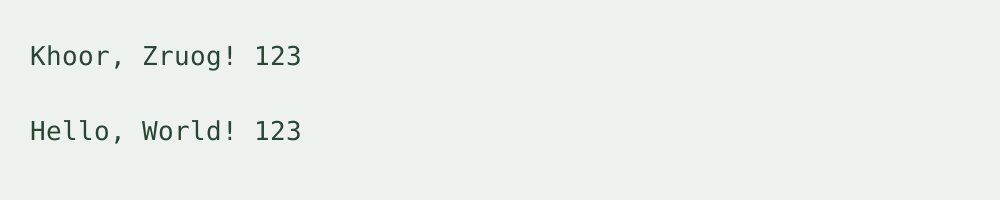
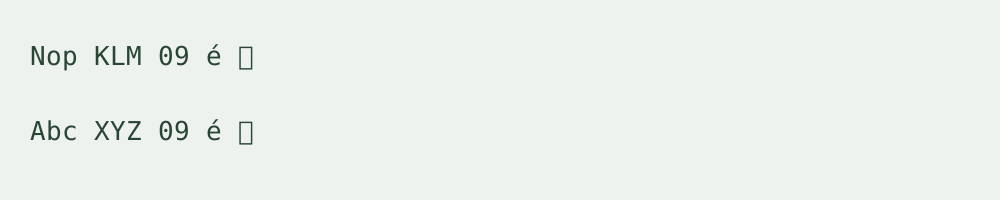
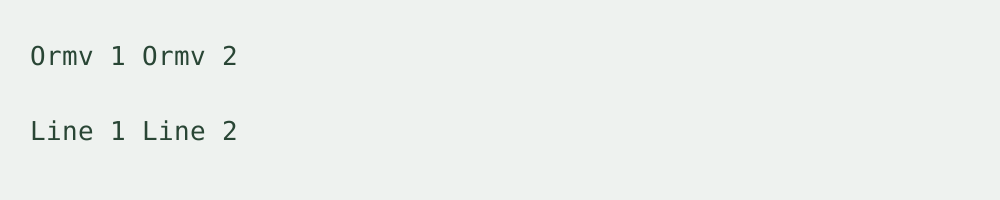
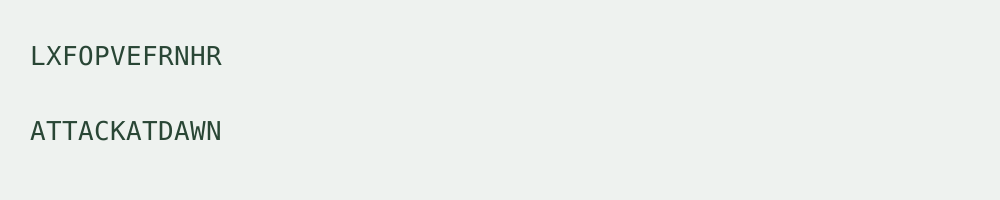
The final row uses the classic ATTACKATDAWN / LEMON example. It is a known-key example, not key recovery. To reproduce a row, paste its generated ciphertext, supply its key only for Vigenere, then inspect the corresponding result block. The line-break sample contains a real newline, displayed as in the table.
Input, output and limits
Paste one text sequence, up to 20,000 Unicode characters per run. Output is labeled text: all 26 Caesar shifts, ROT13, Atbash and optional known-key Vigenere. English A–Z and a–z are transformed with case preserved. Digits, punctuation, spaces, line breaks and non-English letters stay unchanged. No custom alphabet is supported.
Vigenere accepts a supplied key of 1–1,000 English letters, case insensitive. Nonletters in the input do not advance the key. Without a key, Vigenere is not run. An invalid key leaves that block empty with an explicit message; the other blocks remain available.
Processing is local, without login or registration. One input per run; no file upload, batch mode, saved history or daily counter. These classical transformations do not protect confidential information.
Which output is correct?
This tool does not know. It displays alternative transformations without scoring, detection or correctness claims. Readable output alone does not establish the original method or intended message.
Why are ROT13 and Caesar shift 13 the same?
ROT13 is the fixed Caesar shift of 13. Its separate block is a convenience, not another candidate algorithm.
Can it decode Vigenere without a key?
No. It does not guess or recover keys, and it does not claim to crack ciphertext.
Where are the individual tools?
For controlled operations rather than a comparison, use the Caesar cipher decoder and ROT13 tool, Atbash alphabet reversal tool, or Vigenere encrypt and decrypt tool. Caesar and ROT13 share one existing page. Atbash reverses the alphabet without a key; Vigenere uses repeated shifts from your key.
Related representation walkthrough
This existing video demonstrates hexadecimal input and Base64 output, not cipher identification or cracking.
Loading the player connects to YouTube and shares connection information such as your IP address and playback requests.