Hash Identifier
Hash identifier lists possible algorithm families from a digest’s length and character set, with a feature reason for each candidate. It does not determine which algorithm produced the digest.
No digest checked yet.
Ready. Length and syntax are evidence of compatibility only.
Computed length and case checks
We chose four sample texts and computed their digests with Python hashlib and cross-checked them with Node crypto. Both calculations matched every digest byte. The table contains our computed results, not a table copied from another site. For the uppercase sample, we changed only the hexadecimal letter case. Parsing its hex and standard Base64 representations returned the same digest bytes; these checks concern representations of already calculated digest bytes.
| Controlled algorithm | Original sample text | Computed hex digest | Hex case / length | Digest bytes |
|---|---|---|---|---|
| MD5 | abc | 900150983cd24fb0d6963f7d28e17f72 | Lowercase / 32 | 16 |
| SHA-1 | Hash sample one | ddb420a1e5103fdf50eabe5f7bda499b077812b4 | Lowercase / 40 | 20 |
| SHA-256 | Case sample é | FC59B32B25DD86695EDB3263218A63F04171D073539D9631F8AC4E595F5D577F | Uppercase / 64 | 32 |
| SHA-512 | Long digest sample | 57e26fa0d1a3bf0ea7886e2676675881e4f8512bb41976506f498be4b32035dc785090e8ece5e3d7c1c8628bf199511c27feadb6cc56c68e678e01d87c9bb0cc | Lowercase / 128 | 64 |



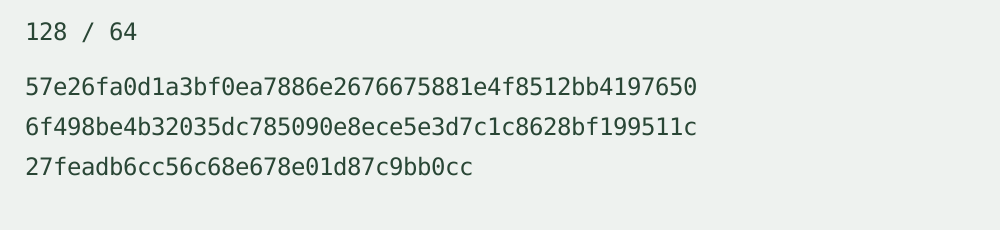
The four controlled outputs have 32, 40, 64 and 128 hex characters, corresponding to 16, 20, 32 and 64 bytes. Each supplied algorithm appeared among the feature-compatible candidates. Other algorithms with the same output length remained in the list. We additionally checked that uppercasing the MD5 hex sample left its candidate list unchanged.
To reproduce a row, use the stated algorithm and exact sample text in an appropriate digest implementation, then paste its computed digest here. Compare the listed features, not an algorithm verdict. The tool examines the supplied digest only. Its candidate outputs contain feature reasons, not sample text.
Supported feature families
Complete hexadecimal pairs give a digest byte length; upper and lowercase are equivalent. Canonical standard Base64 is checked by converting its representation to bytes and back to the same spelling. Spaces and line breaks are ignored. The tool lists known families for 16, 20, 28, 32, 48 and 64 byte outputs. Examples of shared lengths include MD5 and MD4 at 16 bytes, SHA-1 and RIPEMD-160 at 20 bytes, and several SHA-2, SHA-3 or BLAKE2 variants at 32 or 64 bytes. These are candidates, not proof.
Custom digest lengths, truncation, keyed constructions or application-specific formats can share these features or fall outside the list. Prefixed password-record formats and URL-safe Base64 are not parsed here. A no-match result does not establish that an input is not a hash. No probability, ranking or identification accuracy is assigned.
One-way hashes and lookup limitations
Cryptographic hashing is one-way. A precomputed lookup table can only test inputs represented in that table under its exact algorithm and parameters. Rainbow tables trade storage for computation and have similarly limited coverage. Salts, input choices, character encoding and parameters matter; their coverage is limited to the inputs and conditions prepared for them. This page has no lookup-table connection.
Input, output and limits
One digest per run, up to 2,048 input characters including whitespace. Supported inputs are complete hex pairs or canonical standard Base64. Output is a candidate list with a specific representation and length reason per item, plus one-click copy. Unsupported syntax reports no supported representation. One input per run; no login, registration, uploads, batch mode, saved history or daily counter. Processing stays in your browser.
How does it differ from Cipher Identifier?
Cipher Identifier lists candidates from ciphertext notation features. This page examines digest representations and output lengths. Neither tool establishes the exact source algorithm. For controlled digest calculation, use the MD5 Hash Generator or SHA256 generator; MD5 has known collisions and must not be used for security or password storage.
Related representation walkthrough
This existing walkthrough compares character-art representations. It does not identify digest algorithms.
Loading the player connects to YouTube and shares connection information such as your IP address and playback requests.
Watch the existing character representation walkthrough on YouTube