Base32 decode
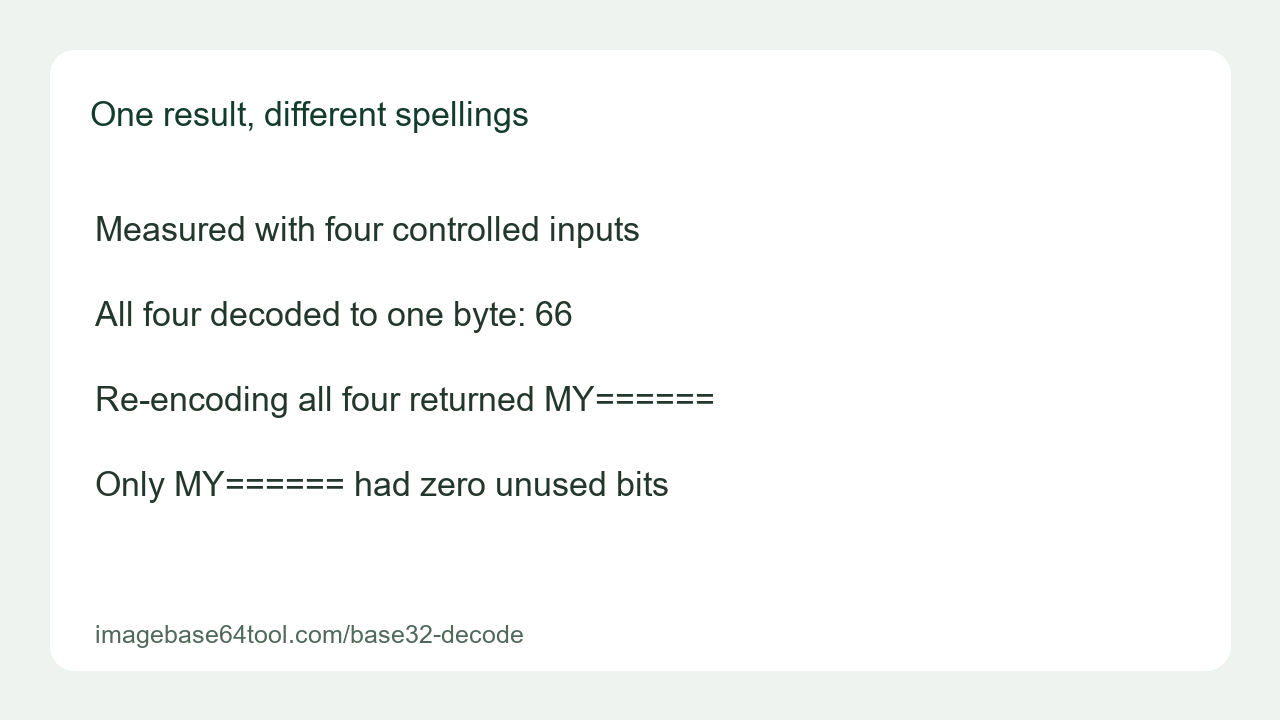
Base32 decode can return identical bytes from different spellings: our four-input experiment returned the byte 66 every time, but only MY====== was canonical.
Ready. Decoding stays in your browser.
Four spellings, one decoded byte
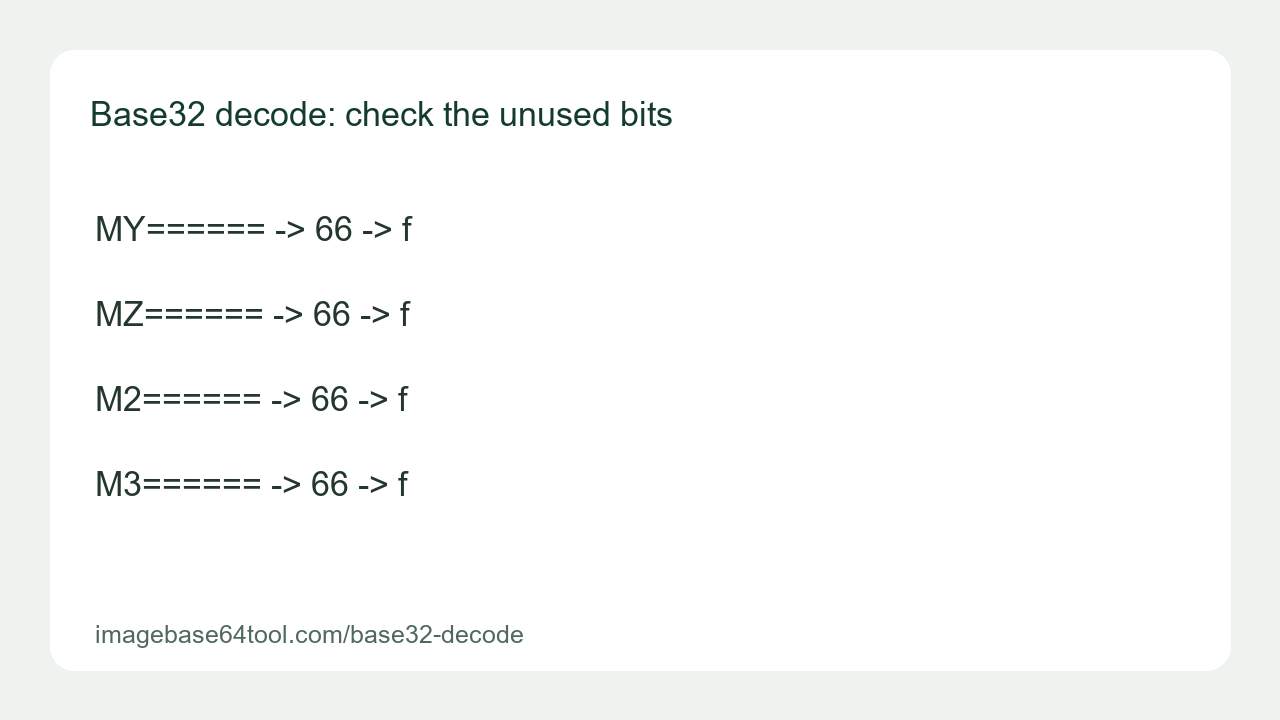
We created four controlled strings by changing only the final non-padding symbol. Python's standard Base32 decoder returned one byte for every input. That byte was hexadecimal 66, displayed as the letter f. We then encoded each decoded byte again. All four results became MY======. The table records this run rather than a prediction about every decoder.
| Input | Decoded hex | Text | Re-encoded | Canonical? |
|---|---|---|---|---|
MY====== | 66 | f | MY====== | Yes |
MZ====== | 66 | f | MY====== | No |
M2====== | 66 | f | MY====== | No |
M3====== | 66 | f | MY====== | No |
Measured input count: 4. Measured decoded byte count per input: 1. Measured matching canonical spellings: 1. Measured non-canonical spellings: 3. These counts came from the recorded input and output rows. No success rate is inferred for other inputs.
To repeat the experiment, paste each table entry with strict mode off. Record the hex output and canonical spelling. Then enable strict mode and decode each input again. The canonical input should retain its result; the other three are rejected by this tool's explicit unused-bit check. Compatible decoding and canonical validation are separate results.
How to decode Base32
Paste a standard Base32 string and choose Decode Base32. Copy the text or download the original decoded bytes. Hex output is available when the bytes do not form readable text. This tool accepts lowercase letters, whitespace and omitted trailing padding. It checks symbol counts and rejects misplaced or incorrect padding. It does not implement Base32hex or Crockford Base32.
Does decoding make an image or file safe?
No. This question follows the safety concern in our material list. Base encoding is a representation, not a scan or encryption. The decoder displays text without executing it and downloads bytes without opening them. A successful decode does not establish what a file will do when opened. The same boundary applies to a Base64 image string.
Why use a separate Base32 decoder?
Base32 and Base64 use different alphabets and bit groupings. A string accepted by one decoder does not prove it belongs to that encoding. Use the Base64 decoder for a Base64 input.
The canonical unused-bit rule is specified in RFC 4648, section 3.5. The table above is our original local experiment.